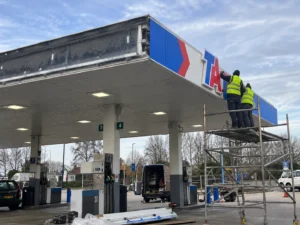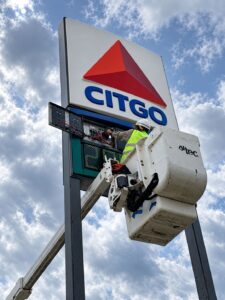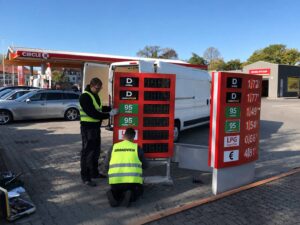
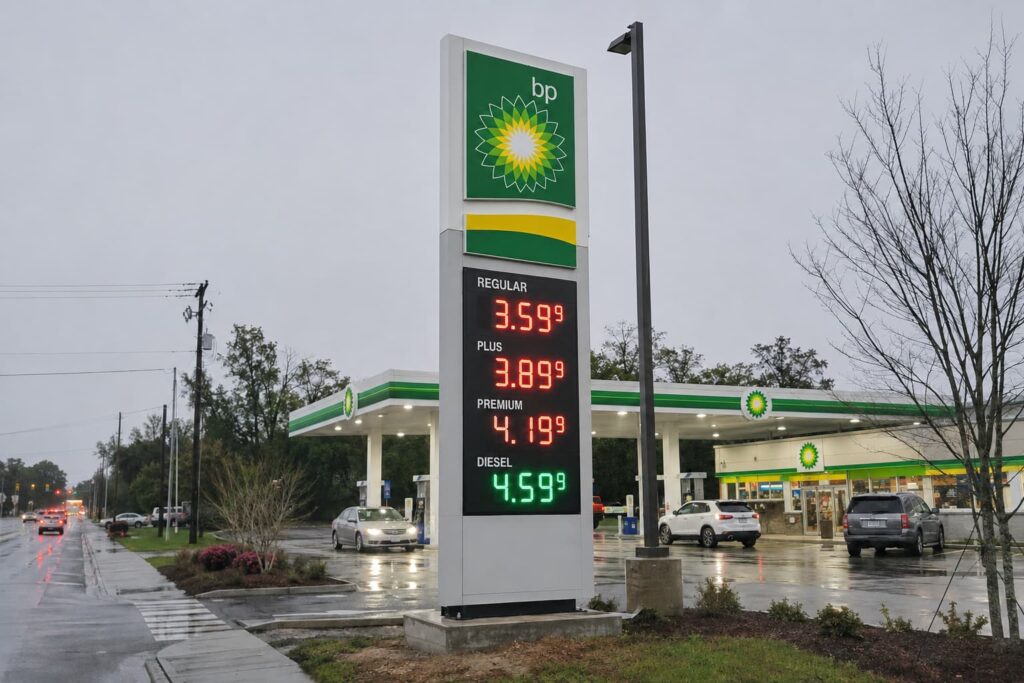
Gas station LED price signs are outdoor displays used on pylons, monuments, and price boards. For new stations, rebranding, and replacement displays, weather resistance must cover more than rain.
Buyers should confirm enclosure protection, drainage, temperature range, UV stability, corrosion control, structural loads, and electrical design. A unit described only as “waterproof” may still trap condensation, fade, overheat, corrode, or fail after unsuitable installation. Matching a gas station LED price sign’s weather rating to the site helps prevent unreadable prices. It also helps avoid service calls and cabinet modifications.
Key Takeaways
- Confirm whether an IP rating covers a module, electrical box, or completed cabinet.
- Match component temperature ranges and thermal management to the site.
- Coastal, high-wind, and freezing sites need tailored specifications.
- Check drainage, cable entries, ventilation, and service access.
How the Price Display Fits the Signage System
An LED fuel price display normally sits inside a pylon or monument. Its ventilation, wiring, drainage, and service access must coordinate with the structure. Brand colors should align with canopy, pump, C-store, and directional signs.
7 Gas Station LED Price Signs Weather Resistance Checks
1. Verify the IP Rating and Its Scope
An IP rating covers enclosure protection against solids and water, not UV, corrosion, temperature, or wind. Request its test basis, installed orientation, and exact assembly covered.
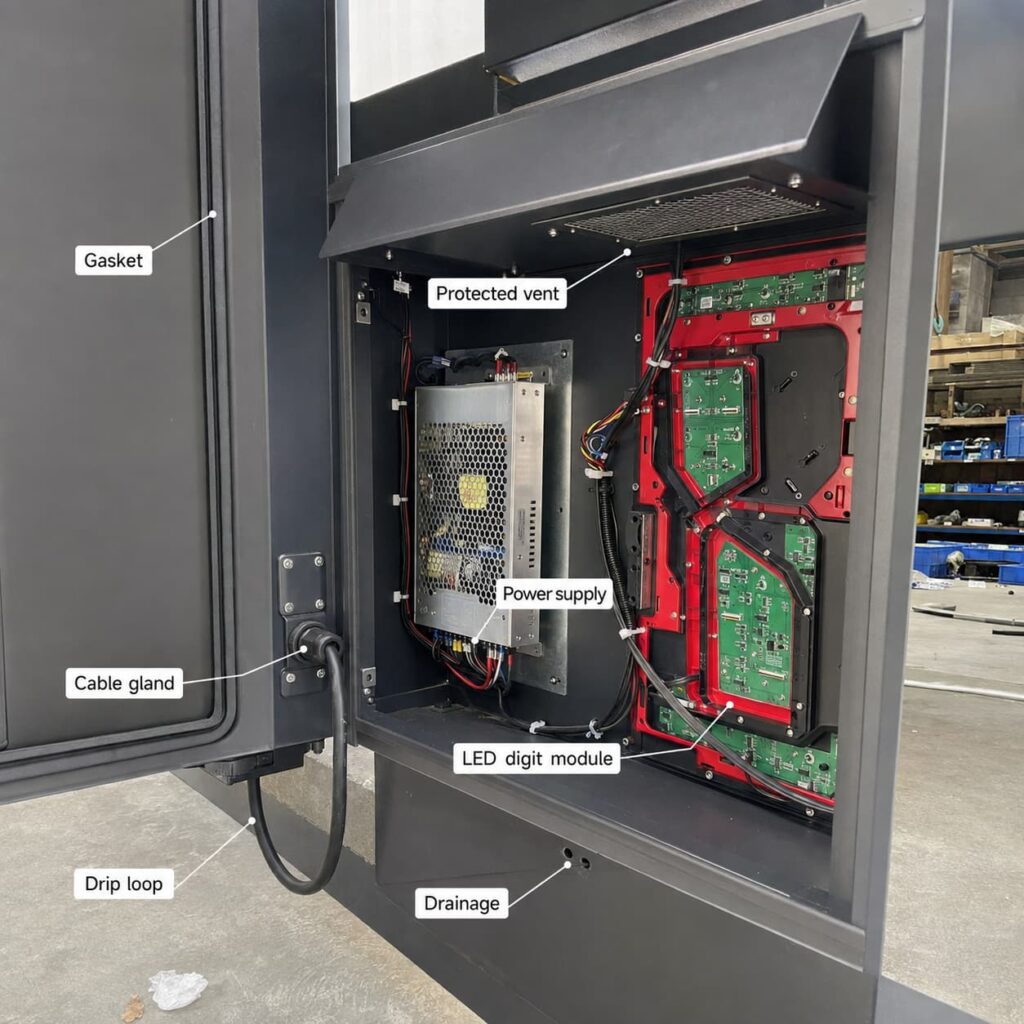
2. Review Sealing, Drainage, and Condensation Control
Check gaskets, overlaps, glands, drip loops, and downward-facing entries. Drains should release water without admitting splash. Sealed cabinets may still need protected ventilation for condensation.
3. Confirm Hot- and Cold-Weather Performance
Provide temperature limits and direct-sun exposure. Confirm operating—not storage—ranges for modules, power supplies, and controllers. Heat dissipation or controlled heating depends on the climate.
4. Specify UV-Stable Exposed Materials
Sunlight can damage faces, labels, paint, sealants, and cables. Specify UV-stable exposed materials and finishes; an approved color sample does not verify long-term performance.
5. Match Corrosion Protection to the Environment
Aluminum reduces rust risk, but internal steel, fasteners, edges, and dissimilar metals still matter. Salt, pollution, or humidity may require treated steel, isolation, and upgraded coatings.
ISO 12944-2 provides a reference for classifying environments that may affect the corrosion protection of steel structures.
6. Confirm Wind, Snow, and Mounting Loads
The cabinet, brackets, frame, pole, anchors, and foundation form one load path. Provide the site and mounting height for local wind, snow, or ice review.
For U.S. projects, the ASCE Hazard Tool can provide location-specific wind, snow, and ice data for engineering review.
7. Check Outdoor Power, Controls, and Service Access
Confirm voltage, grounding, surge protection, sealed connectors, controller location, and update method. Service doors should allow component replacement without dismantling the pylon.
Climate-to-Specification Comparison
| Site | Confirm | Response | Risk |
|---|---|---|---|
| Rain/humidity | Water/condensation | Seals, drains, vents | Fogging/shorts |
| Heat/sun | Temperature/UV | Heat control, stable faces | Overheating/fading |
| Freeze/snow | Range and loads | Rated parts; heating if needed | Start-up/damage |
| Coast/industry | Corrosion/interfaces | Coatings, compatible fasteners | Corrosion |
| High wind | Site, height, area | Engineered load path | Vibration/failure |
What Affects the Cost?
Cost depends on digit size, rows, quantity, faces, cabinet construction, rated components, coating, thermal equipment, controls, service access, reinforcement, documentation, packing, and shipping. Installation and local engineering may be separate. Compare quotations against the same approved scope.
Common Procurement Risks
- Applying a module IP rating to the completed cabinet.
- Specifying an airtight box without heat or condensation control.
- Omitting climate, voltage, height, or wind data.
- Combining protected cladding with untreated fasteners or steel.
- Omitting access, spares, or controller protection.
Resolve each issue in the drawing and bill of materials before production.
What a Practical Factory Review Should Cover
Pre-shipment checks should cover joints, gaskets, cable entries, drainage, wiring, dimming, price updates, and stable operation. Claimed ratings or temperature ranges need applicable supporting documents. Export packing should protect digit faces and identify controls and spares.
Information Needed Before Requesting a Quote
Send the supplier:
- Cabinet/digit dimensions, quantity, and faces
- Fuel grades, price format, rows, color, and controls
- Site photos, road direction, viewing distance, and mounting height
- Location, climate, voltage, and frequency
- Logo files, deadline, and local structural requirements
gas price sign sizing and quotation guide
FAQ
Does IP65 make an LED gas price sign completely waterproof?
Not necessarily. An IP code describes tested protection against solids and water for a defined enclosure and condition. It does not prove resistance to UV, corrosion, heat, cold, wind, flooding, or condensation. Confirm whether it applies to the digit module, electrical box, or complete sign.
What materials are suitable for coastal gas stations?
Selection depends on salt exposure, humidity, maintenance, and the supporting structure. You may need aluminum cabinets, internal steel protection, suitable fasteners, isolated dissimilar metals, sealed electrical parts, and an environment-matched coating. Confirm the final specification with the project engineer or coating specialist.
How do price signs handle extreme heat or cold?
All LED modules, controllers, and power supplies need operating ranges suitable for the site. Cabinet temperature may exceed ambient temperature in direct sun.
Hot sites may need better heat dissipation. Cold sites may need low-temperature parts or thermostatically controlled heating. This depends on the approved design.
Can you install a weather-resistant display in an existing pylon?
Often, but first survey the opening, cabinet depth, frame capacity, cable route, ventilation, drainage, voltage, and service access. The structure may need engineering review for revised weight or wind area. Send measured drawings, mounting details, and site photos before design.
What maintenance should we plan before ordering?
Specify accessible service doors, replaceable modules, labeled wiring, protected controllers, and an agreed spare-parts list. Periodic inspections should check seals, drains, vents, coatings, fasteners, and electrical connections. The schedule depends on the environment, local safety procedures, and component manufacturer instructions.
Conclusion
Good gas station LED price signs weather resistance comes from coordinated enclosure, electrical, material, drainage, thermal, and structural specifications—not one “weatherproof” label. Send us your logo, size, quantity, and pricing layout.
Also include your locati0n, voltage, climate details, and site photos.
We will review these and suggest a suitable configuration.