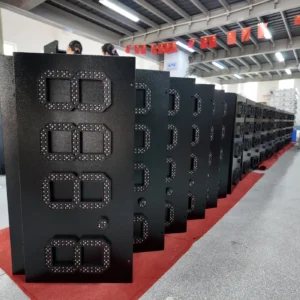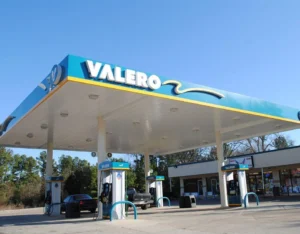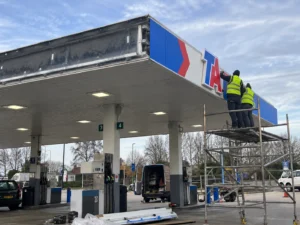
A service station canopy can look aligned in a branding rendering but present fabrication problems. A logo may cross a panel joint, an LED band may break at a corner, or new cladding may not fit the retained roof.
These conflicts are easy to miss in a front-view image. Here is how to coordinate fascia panels, illuminated logos and accent lighting before production.
Most searches for a service station canopy start with the structure: span, clearance, steel and under-canopy lighting. This article covers the layer that is specified last and corrected most often: the fascia, logos and LED band the canopy carries. If the structure is still undecided, settle that with a canopy engineer first. If it is fixed, the checks below are what stand between an approved rendering and a fascia that fits.

Start With the Canopy Fascia, Not Just the Artwork
The full canopy includes a roof and supporting structure. Its fascia carries brand colors, logos and illuminated details. Fabricating a new fascia does not mean supplying or approving the structure behind it.
Review all canopy elevations, not just one perspective rendering. Check logo placement on each face, corner transitions and the continuity of color bands.
The most prominent face for arriving drivers may not be the longest face, so assess the artwork from realistic approach angles as well.
Brand rules may also settle decisions that look purely aesthetic. For example, Phillips 66’s published station requirements specify a 36″ or 48″ flat fascia and square canopy corners for its branded sites.
Make Panels, Corners and Logos Work Together
A long fascia is assembled from sections, so the layout must show panel joints, corner returns, logo mounting areas and connections. Four rules settle most conflicts before they reach the factory:
- Fix the logo position first, then draw the panel joints around it. A logo should sit inside one panel, or be centered on a joint on purpose, never with a joint falling somewhere inside its clear zone.
- Set the LED band height from the fascia datum, not from each panel. Use the top or bottom edge as the reference. A panel that is a few millimeters off then shifts the joint, not the light line.
- Decide at every corner whether the band runs through the return or stops short of it. Renderings never show this; the return drawing must.
- Every driver and power supply must be reachable by removing one panel. If the layout cannot show which panel, the layout is not finished.
| Rendering shows | Fabrication question | Decide before approval |
|---|---|---|
| Centered logo on the long face | Does a joint fall inside the logo clear zone? | Re-module panel widths or shift joints |
| Continuous LED band | Is band height set from the fascia datum or per panel? | Datum-based; confirm corner run-through or stop |
| Clean corner | Does the return carry color, band and profile? | Detail the return piece, not just the color |
| Nothing (access is never rendered) | Can each driver be reached by removing one panel? | Mark removable sections on the layout |
Material choice affects how these details are executed, and the separate canopy materials guide explains those trade-offs.
Treat the LED Band as Part of the Fascia Design
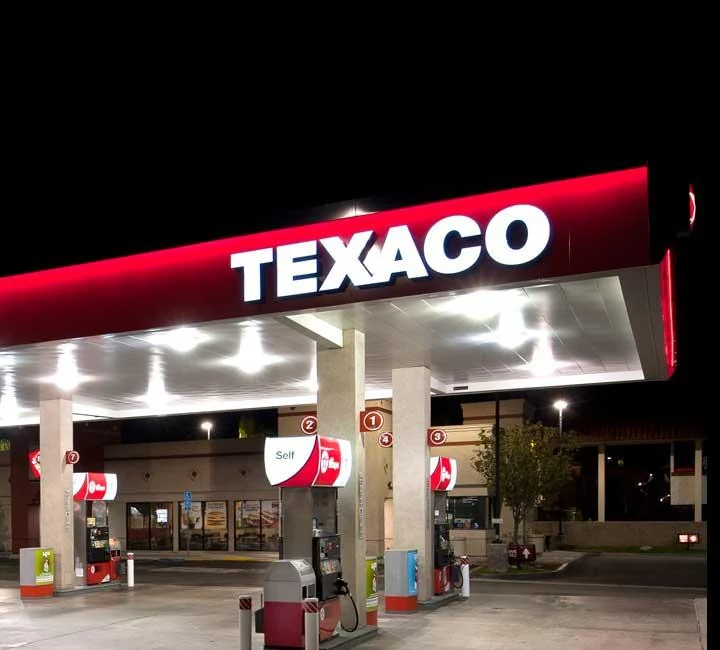
A continuous illuminated line has sections, corners, connections and service points. A slight change in height between panels can become obvious after dark.
Check the daytime appearance as well: a dark or contrasting lighting channel may interrupt the fascia color even when the LEDs are off. At night, the concern changes to uneven sections or visible breaks. Brighter lighting alone will not correct a misaligned line.
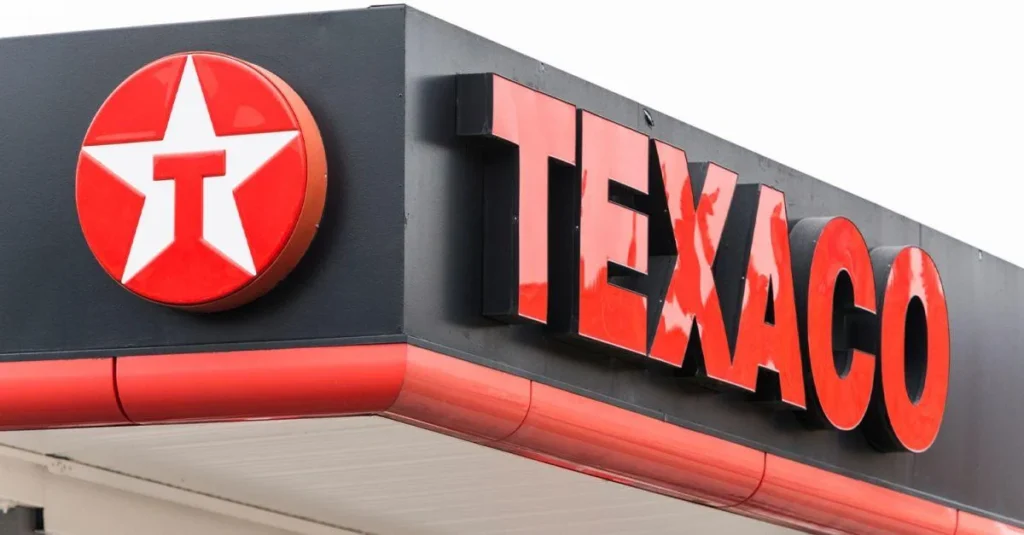
A New Canopy and an Existing Canopy Need Different Reviews
For a new station, logo mounting zones, fascia profiles and access openings can be coordinated before structural and electrical interfaces are finalized.
At an existing station, retained corners, cladding, attachments and cable access limit design choices, and an old fascia may conceal mounting conditions an earlier drawing cannot confirm.
Fresh panels must not hide corroded supports or unresolved roof problems; those need local assessment before the branding design is finalized. The canopy refacing or replacement guide covers that decision in greater depth.
Local sign rules also matter. For example, Sidney, Ohio’s canopy sign ordinance limits canopy signs to one square foot per lineal foot of canopy frontage and does not allow them to project above or below the canopy facade. Rules of this kind can override a brand layout, so check them before the elevation is approved.

What a Fabrication Review Should Actually Resolve
Approval of brand artwork confirms the intended appearance, not the fabrication details. A separate review must resolve panel splits, corner returns, logo fixing zones, lighting connections and access.
Compare the overall elevation with the component drawings: panel identifiers should match their intended positions, the logo mounting zone should stay clear, and the planned service openings should remain accessible.
Grandview’s SURE petrol station canopy signage project in Australia followed exactly this order: the red fascia, white band and logo were placed on the elevations first, panel divisions and corner returns were then mapped to the logo and light line, and cable routes came last. That sequence, not the color, is what kept the band level across every section.
None of these checks replaces structural or electrical approval; the local engineer, electrician and authority still sign off the canopy itself.
FAQ
Can the branding on an existing service station canopy change without replacing the roof?
Sometimes. If the existing structure can remain, updates may involve only fascia, logos and lighting.
Is an approved canopy rendering enough to start fabrication?
No. A rendering conveys appearance, but the fabrication review must address joints, mounting, corners, illuminated components and site interfaces.
Conclusion
A service station canopy fascia must work as both a coherent design and a manufacturable assembly. For examples of the components involved, explore custom gas station canopy fascia signage.