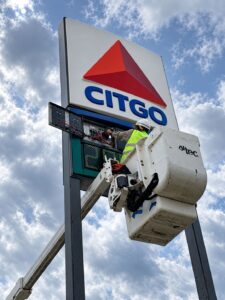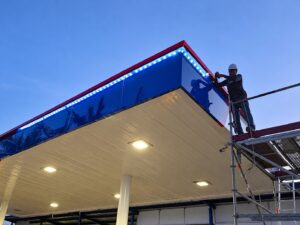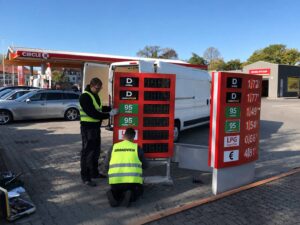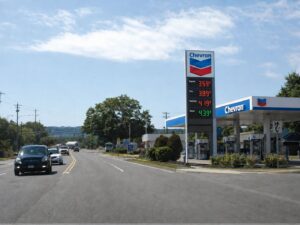
An existing fuel station may need a new brand image without needing every sign structure replaced. For an existing-site project, fuel station redesign services should begin with a component-level review: what can stay, what can be refaced, what needs a retrofit, and what should be replaced?
Those decisions affect downtime, brand approval, price-sign operation, and whether new signage will actually fit retained site conditions. A pylon, LED price section, canopy fascia, pump graphics, and store sign may have been updated at different times, so the redesign must resolve their interfaces before fabrication.
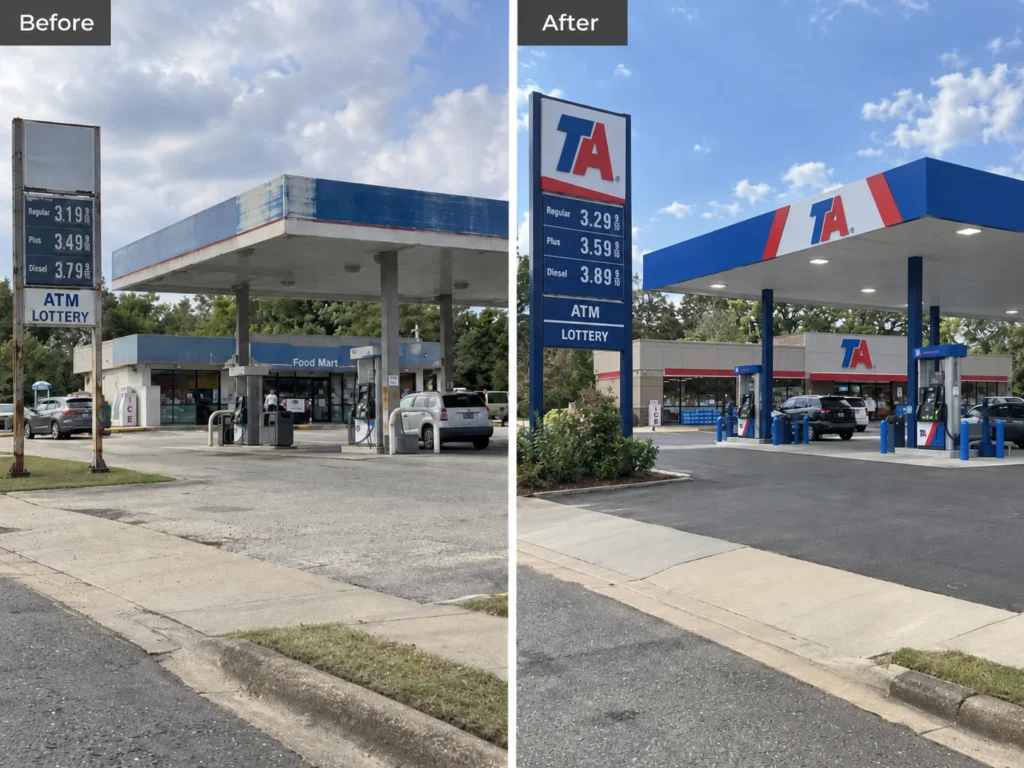
Start With a Component-Level Site Survey
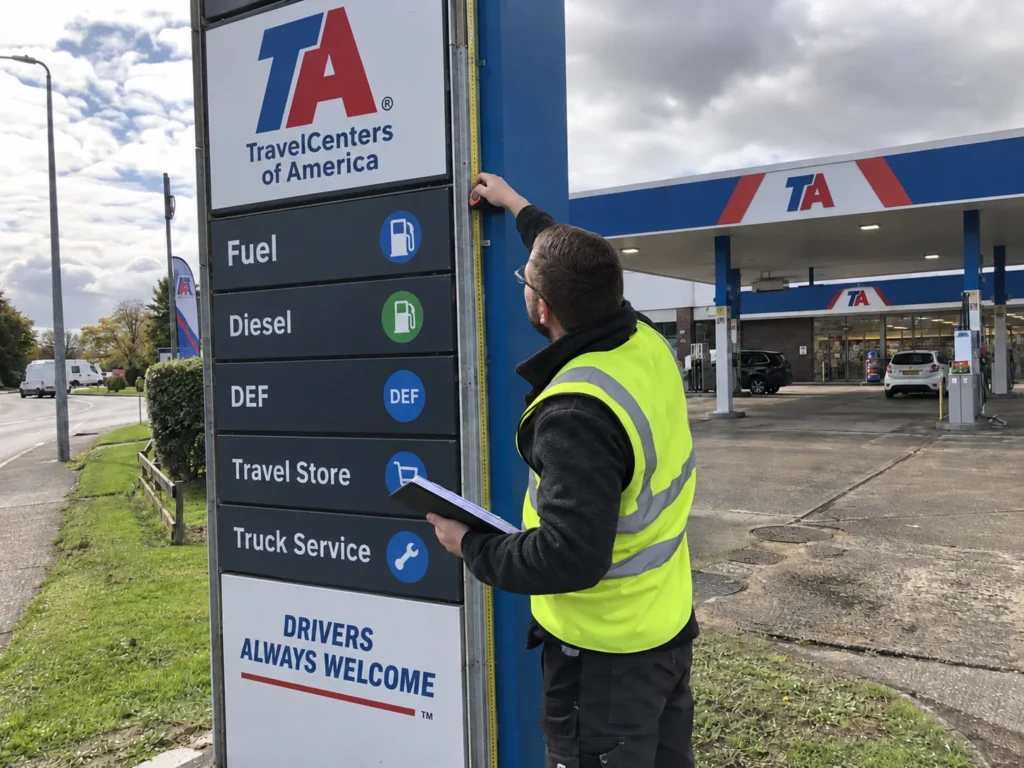
A redesign drawing is only reliable when site conditions are verified. The survey should confirm overall sign and cabinet dimensions, visible face areas, openings, panel breaks, mounting positions, cable-entry points, access doors, and the clearance needed for future servicing.
Condition matters as much as size. A cabinet may look reusable but still have corrosion, damaged access panels, unsuitable fixing points, or internal restrictions. Retained supports, foundations, or canopy structures should be checked by the appropriate local engineer or qualified contractor when structural review is required.
For an LED price section, also record the existing power arrangement, controller, communication method, wiring path, and service space. The factory can review the supplied equipment and fabrication interface; local electrical approval and onsite connection remain local responsibilities.
Keep, Reface, Retrofit, or Replace?
| Component | What to Confirm | Possible Direction | Critical Interface | Who Verifies? |
|---|---|---|---|---|
| Pylon / MID | Cabinet condition, face size, access, retained support | Keep, reface, modify, or replace selected sections | Mounting, panel openings, logo and price zones | Factory reviews fabrication interface; local team verifies site and retained structure |
| LED price section | Display condition, cabinet space, controller, wiring | Keep, retrofit, or replace price cabinet | Power, control compatibility, service access | Factory checks supplied system; local electrician checks site connection |
| Canopy fascia | Existing fascia, panel layout, logo positions, support condition | Reface branding layer or replace fascia panels | Panel alignment, fixing points, logo mounting, lighting | Factory reviews panel system; local team verifies existing canopy |
| Pump branding | Dispenser dimensions, old graphics, obstructions | Replace graphics, toppers, or identifiers | Attachment areas and operating clearances | Site dimensions verified locally; factory produces approved components |
| C-store sign | Sign band, mounting surface, electrical provision | Reface, replace face, or install new identification | Mounting, wiring, service access | Shared review; local installer confirms field conditions |
This is a decision framework, not a universal engineering rule. The real condition of each component controls the final direction.
For canopy-specific decisions, see Grandview’s canopy gas station upgrade guide. For roadside price displays, the LED price-sign retrofit guide separates the cabinet, display, and retained pylon instead of treating them as one replace-or-keep decision.
Coordinate Logo, Color, Illumination, Alignment, and Price Visibility
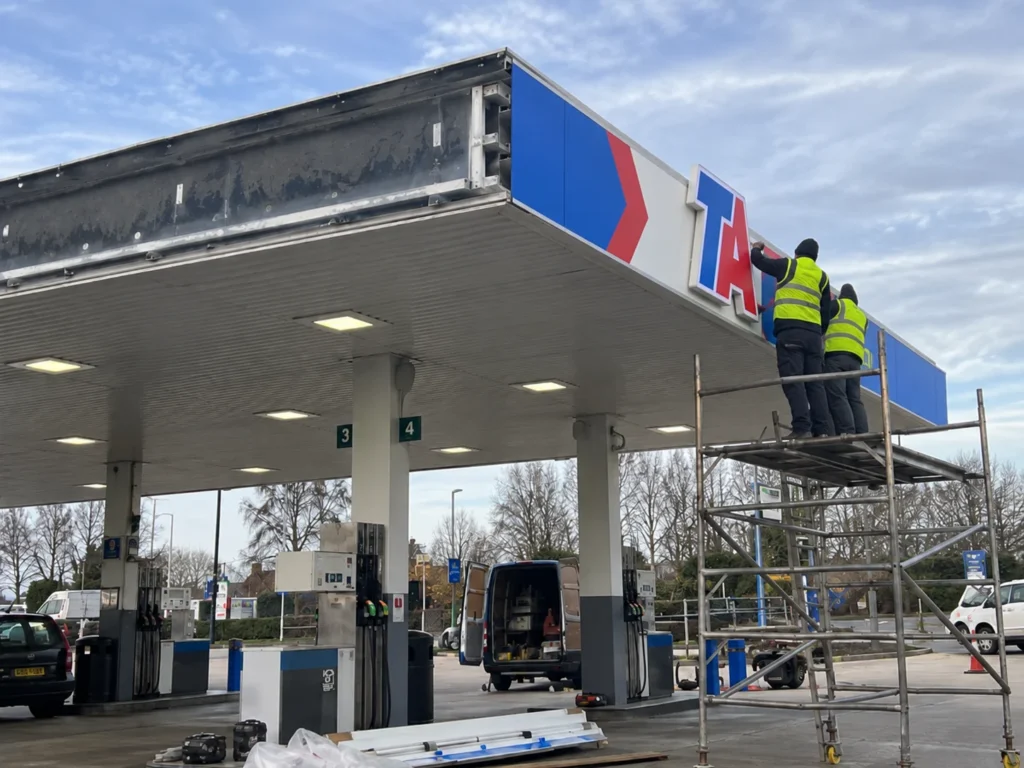
A coordinated redesign needs review criteria, not the vague instruction that every sign should “feel related.”
The logo should use approved artwork, proportions, orientation, and placement. It should not be stretched simply to fill an existing panel. If an old pylon or fascia has different proportions from the new brand standard, the panel layout should be adjusted rather than distorting the logo.
Brand colors should follow the approved color reference and be reviewed across the actual production methods. Painted metal, printed graphics, translucent faces, and illuminated elements can present the same brand color differently. Approval therefore needs to cover the intended material and day/night appearance, not only the color shown on a screen.
Illumination should be defined before production. Drawings should identify which logos, letters, sign faces, or price displays illuminate and what the intended night appearance is. For electric signs and retrofit components, applicable electrical requirements require project-specific review. UL Solutions lists UL 48 for electric signs, UL 879 for sign components, UL 879A for LED sign and sign retrofit kits, and NEC Article 600 among common standards and requirements.
Information hierarchy should follow the driver’s path. Roadside signage normally carries the highest-priority brand and fuel-price information. The canopy reinforces identification once the station is in view, while pump and store signs operate at closer range.
The objective is not to make every sign the same size. It is to prevent the logo, fuel prices, service information, and directional messages from competing for the same visual priority.
Panel alignment is a fabrication issue as well as a design issue. Logo edges, color bands, illuminated strips, and graphic transitions should be checked against real panel joints, cabinet openings, and fixing locations before drawings are released. A major logo or color band should not be split simply because the rendering ignored how the fascia or cabinet is actually divided.
Price visibility should be checked from the real vehicle approach and against the approved roadside layout. The number of price rows, digit arrangement, surrounding brand panels, viewing angle, and roadside obstructions all influence what motorists see. A redesign should therefore use actual site conditions instead of relying on a universal viewing-distance claim.
For projects involving several sign types, Grandview’s complete gas station signage system shows how roadside, forecourt, and building signage can be planned as different parts of one site package. The Meru Sombetini gas station branding project also shows pylon, fuel-price, canopy, pump, and directional elements carrying different information roles within one visual system.
Use a Controlled Redesign Workflow
For an operating station, the sequence should be agreed before fabrication:
- Survey the site — confirm dimensions, condition, interfaces, electrical/control information, access, and local constraints.
- Make the retain/replace decision — mark each component as keep, reface, retrofit, replace, or local-review-required.
- Obtain brand approval — confirm logo artwork, color references, hierarchy, price layout, and illumination intent.
- Prepare production drawings — resolve panel divisions, mounting points, wiring interfaces, service access, and labeled components.
- Complete local approval — address required structural, electrical, permit, or authority reviews.
- Fabricate and test — manufacture approved components and test functions within the supplied scope.
- Install in phases — coordinate removal, temporary conditions, installation, and commissioning.
Downtime should be planned with installation. If a roadside pylon or price display must be offline, the owner and installer should agree when that happens and what customer-facing information remains available during the work.
Price synchronization needs the same discipline. If an existing display is retained or a new display connects to existing controls, confirm how prices will be updated and whether the controller, communication method, wiring, and new display are compatible.
Do not assume an existing remote, POS connection, wired link, or other control method will work with replacement hardware until compatibility has been verified.
Brand approval should occur before fabrication files are released. A finished rendering is not enough if the logo version, color reference, price hierarchy, or illuminated treatment is still awaiting approval from the brand owner or project decision-maker.
Old-brand removal also creates project risk. Removing sign faces, graphics, fascia panels, or illuminated elements can expose hidden damage, old fixing holes, adhesive residue, mismatched finishes, concealed corrosion, or dimensions that differ from the visible face.
The installation plan should allow those conditions to be checked before new panels or graphics are installed.
Separate Factory Review From Local Responsibility
Fuel station redesign services cross factory and local responsibilities.
The factory can review artwork, layouts, cabinet and face construction, supplied LED components, production drawings, assembly, testing, packing, and agreed installation references. Site conditions should not be treated as verified unless the responsible local party has actually checked them.
Retained structural supports, foundations, wind-load requirements, final site measurements, onsite electrical connections, local code compliance, permits, and installation depend on the project location and should be handled or verified by the appropriate local engineer, electrician, installer, and authority.
The International Sign Association states that installing a new sign requires a permit in most communities. It also notes that local permitting can include code-based administrative review and a separate design review.
A factory production drawing should therefore be treated as a manufacturing document, not as automatic local permit approval.
FAQ
Does a fuel station redesign mean replacing every existing sign?
No. Existing components should be reviewed individually. A usable pylon structure may receive new faces or a redesigned price section, while canopy fascia or pump branding may be updated separately. Retained structural and electrical conditions still require the appropriate project-specific verification.
Can an existing LED price display be kept during a redesign?
Possibly, but appearance is only one part of the decision. The project should confirm cabinet space, display condition, control method, wiring, power, service access, and compatibility with the redesigned price section before deciding to retain it.
Conclusion
A redesign is ready for production when the verified site conditions, approved brand system, electrical and control interfaces, local responsibilities, and installation sequence agree with the drawings.
Grandview can review the signage scope for an existing station upgrade and help convert an approved redesign into project-specific manufactured signage.
References / Further Reading
International Sign Association — Permitting Resources
International Sign Association permitting guidance
UL Solutions — Electric Sign Certification and Sign Component Solutions
UL Solutions electric sign and retrofit standards overview